





Small Caucus, Mighty Legislative Agenda
By Jane Latus
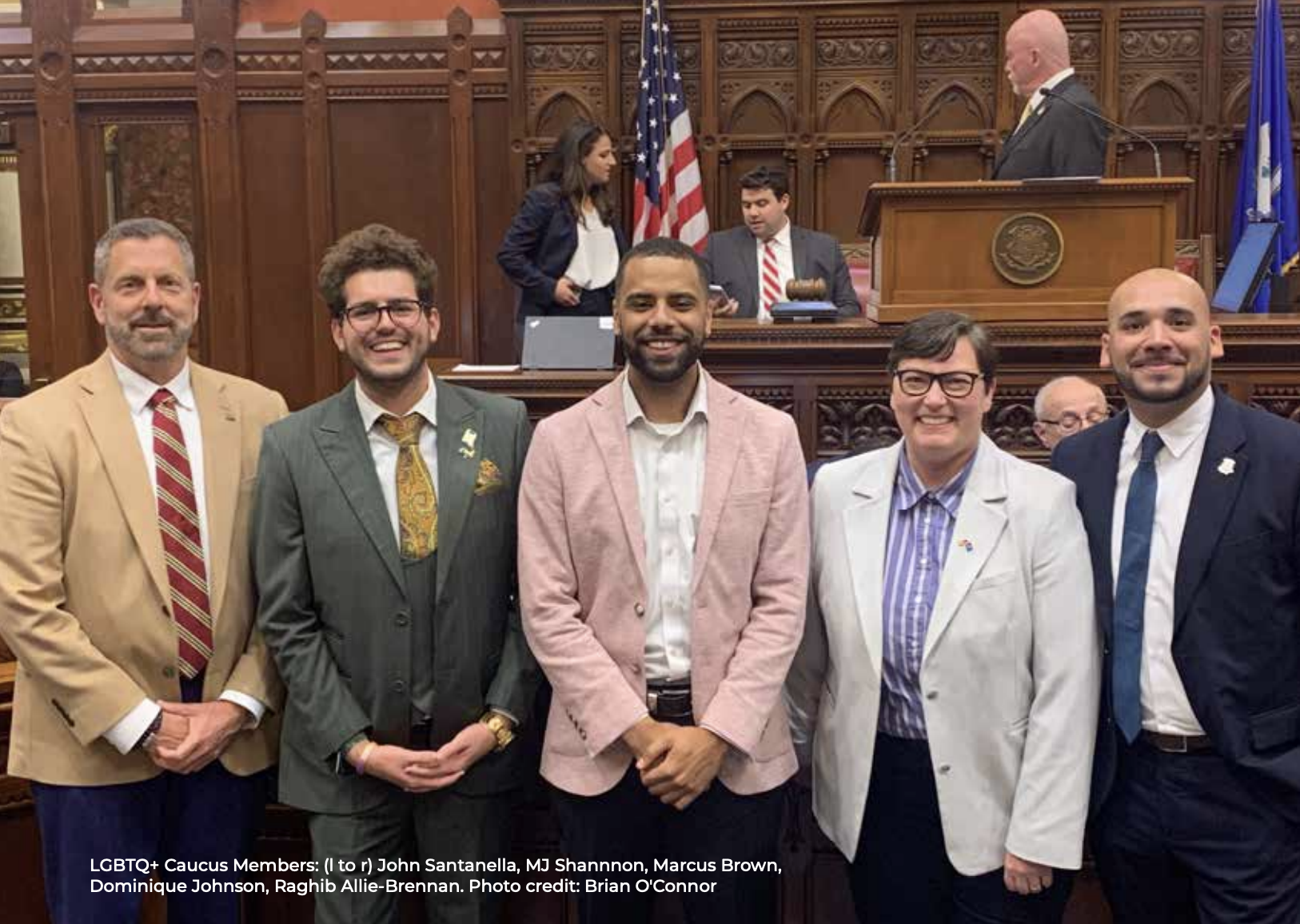
If you’re expecting less progress from this year’s legislative session just because it’s a short one, leaders of the legislature’s LGBTQ+ caucus—also small, at only five members—urge you to raise your expectations. “When we work together, we can get really big things done,” says Rep. Dominique Johnson of Norwalk and Westport. “We’re punching above our weight,” adds Rep. Raghib Allie-Brennan of Bethel and Danbury
The two are co-chairs of the caucus, which also includes representatives John Santenella of Enfield, Marcus Brown of Bridgeport, and MJ Shannon of Milford, Orange and West Haven.
“Right now we’re having to put our shoulders into things we didn’t think we’d have to, but I believe in progress,” says Johnson. Allie-Brennan stresses that despite current attacks on LGBTQ+ rights, the caucus is proactive. “We’re not reacting to headlines. We’re making sure laws focus on people’s lives, especially access to healthcare and education.”
Current elected officials and candidates should take heed that Connecticut residents expect progress on LGBTQ+ issues, says Matthew Blinstrubas, executive director of Equality CT, the nonprofit working to advance LGBTQ+ rights and culture. “We expect results on LGBTQ+ issues, and we expect resources.” Last November saw what he calls “a mini queer wave” in local elections, he adds. “LGBTQ+ people are running and winning.”
Johnson and Allie-Brennan say caucus members spent the past few months meeting with individuals, advocates and organizations to hear their needs and to prioritize goals for this session, which began February 4 and ends May 6.
Their strategy is necessarily different during short sessions, when procedural rules are different. Some long-term goals likely won’t be achieved—like a constitutional amendment prohibiting discrimination based on gender identity or sexual orientation. On the other hand, less time should be wasted on fending off attack bills, since only committee chairs are allowed to introduce bills.
“Our approach is to stay focused on policy and facts and the impact on people’s lives. Part of our job, too, is humanizing the LGBTQ+ community,” says Allie-Brennan. Putting a face on policy is why it’s so important for individuals to testify, he adds, especially on trans issues, since the caucus doesn’t include anyone who is trans.

Speaking of which: Johnson hopes that transgender candidates will come forward. She recalls being in junior high school when the state passed the gay rights bill. “We stand on the shoulders of those who worked to pass that bill,” she says, and she hopes current events will spark interest in others becoming future leaders, and that LGBTQ+ representation will become increasingly diverse.

Despite its size, the caucus has a broad reach, with members serving on these committees: Government Administration and Elections; Energy and Technology; General Law; Insurance and Real Estate; Environment; Joint Commission on Judiciary; Commerce; Planning and Development; Public Safety and Security; Finance, Revenue and Bonding; Appropriations, and Transportation. Johnson also serves as deputy majority leader.
“We’re really lucky to have such a strong caucus,” says Equality CT’s Blinstrubas. The caucus’s agenda in most part overlaps that organization’s own 2026 legislative agenda, which can be seen at eqct.org.
Following are the caucus’s goals for this session.
Fertility Treatment for All
This effort to require that insurers cover fertility treatment for everyone is bipartisan. Johnson is working with Republican Tammy Nuccio to modernize this statute that “has outdated assumptions about who forms a family,” says Johnson. “It excludes single women, queer women, and gay men.”
She has heard from queer women who want to start families but have to choose between paying for fertility care, a home down payment or a wedding.
Johnson expects this bill to be an easy win, and one that “would make an immediate impact for people who have insurance but can’t access it. Insurance covers it, but for other people.”
Strengthening Healthcare Provider Protection
A chief caucus goal is to update the existing shield law to include telehealth providers of reproductive and gender affirming care, no matter where the patient is located, and to clarify that anti-gender affirming care and anti-reproductive care laws in other states cannot apply in Connecticut.
The proposal would also shield providers from out-of-state subpoenas and requests for data.
“Providers are nervous. There are providers who are not doing this because of the uncertainty,” says Allie-Brennan.
Easing Access to Hormones
No matter the reason a person is prescribed hormones, the caucus’s goal is to require the ability to obtain a 12-month supply to help ensure stable, uninterrupted care.
Additionally, Equality CT is advocating that providers of both gender affirming and reproductive care be allowed to write prescriptions using their clinic’s or practice’s name, rather than their personal name. Equality CT also advocates that testosterone be made more accessible by removing it from the controlled substance list.
Funding the LGBTQ+ Justice & Opportunity Network
Increasing funding for this first-of-its-kind in the nation network is a top priority, says Allie-Brennan, who along with past State Rep. Jeffrey Currey introduced the bill that created it in 2017.
Funded and administered by the state, the network funds and collaborates with LGBTQ+ organizations statewide and advises the legislature on queer issues. It conducted the first needs assessment on statewide health and human services issues.
You can learn more about the network in “Queer Joy and Resilience” in the June 2025 issue of CT Voice and at ctlgbtqnetwork.org.
Supporting Planned Parenthood
In last fall’s emergency session, the legislature approved a $500 million emergency relief fund to replace federal cuts to healthcare, housing and social services programs. The caucus is particularly concerned, looking ahead to 2027, that money be available for Planned Parenthood.
“Planned Parenthood is already a really important healthcare provider for our LGBTQ+ community,” and has become even more so as other providers “pre-comply” with federal policy says Johnson, referring to the decisions by Yale New Haven Hospital and Connecticut Children’s Medical Center to end gender affirming care for approximately 1,000 youths.
Safe Educational Environment
“There are gaps in how anti-discrimination laws are applied. We want to ensure that students in every school district are safe from discrimination,” says Allie-Brennan.
The problem, according to Melissa Combs, founder of the Out Accountability Project (which seeks safe, affirming schools), is a loophole that allows schools to process discrimination complaints via federal Title IX or Section 504 policies, rather than via state statute. Even without the current federal antipathy toward queer rights, federal processes are cumbersome, inefficient and—adds Combs—tilted toward an outcome that protects the school rather than the student.
Combs says this loophole leaves 67 percent of Connecticut’s children, including about 6,471 queer kids, without protection at a time when bullying is on the rise. And not only from peers. “I got a call from a nonbinary child whose principal told them, ‘My president says there are only two genders.’”
Training 211 Operators
“Calls to 211 from LGBTQ+ people, especially youth, have gone up drastically” since the end of federal funding for LGBTQ+ youths’ calls to the 988 suicide hotline, says Johnson.
“Not only do we need to keep funding it, but we need to be sure operators are culturally competent and supportive,” she says.
Allie-Brennan points out that shoring up the 211 service is an example of progress that could be achieved without legislation, but instead through conversation.
One additional ongoing priority of the caucus is to be vocal and visible on behalf the trans community, says Allie-Brennan. Stay tuned, he says, for opportunities for community members to engage with legislators and officials including Attorney General William Tong. “We want people to know we stand with them.
More Stories
RUFUS WAINWRIGHT
“It’s very scary and very exciting”: Jacques Lamarre on the World Premiere of Circus Fire and Building a Life in Hartford
How Can They Keep from Singing?