





The Costs of the Closet
BY CHRISTOPHER BYRNE
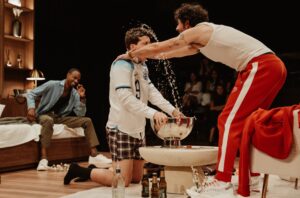
There are two basic premises at work in The Pass, now at LaMaMa in Manhattan through September 4. The first is that being gay in professional sports is a dealbreaker (literally, too, when it comes to endorsements). The second is that fame is a Faustian bargain in which the price of glory is the loss of one’s soul.
These are well-worn themes in literature and theater, and it seems obvious that the decision to mount this 2014 play about soccer (aka “football”) is as much market responsive as it is artistic. After all, the book and Netflix series Heated Rivalryabout gay hockey players is very buzzy right now, and we’ve just come off the World Cup.
John Donnelly’s play is attempting to be less sudsy as he grapples with these issues, but he never seems to get a firm hold on them. The story unfolds in three hotel rooms over 12 years. In the first Jason and Ade are 17-year-old soccer hopefuls competing for one coveted slot on a major team. Their horseplay turns sexual but is framed in the context of youthful exploration—at least on the surface.
In the second scene Jason is in a hotel room in Spain where he has brought back Lyndsey, a table dancer from a nightclub. Jason is married with a kid, but rumors persist of his homosexuality. It becomes clear that Lyndsey has been hired to get dirt on Jason and after banter and conflict—and the reveal of Lyndsey’s trick—Jason plays along and ends up making a sex tape, which is then released, but provides his heterosexual bona fides.

In the final scene, they are back in yet another hotel room. Jason has texted Ade to come, and he has—after a dozen years of no contact. Jason has by this time become a major sports celebrity. Ade by this time has moved on, made a kind of peace with his not becoming a soccer star, has a boyfriend, and a thriving business. There may be regrets for Ade, but they do not control his life. Jason, however, has become a kind of monster, cruel, aggressive, and trying to lord his stardom over Ade, though he admits that Ade was the better player. It’s implied that Jason’s career decided by that fateful game and subsequent fame is due to a showboating goal in that game where he didn’t pass the ball to Ade to score. There’s a lot of circular talk, which echoes the first scene where they couldn’t acknowledge the truth of their sexuality. Jason says that night was the last authentic feeling he had, perhaps in a desire to rekindle a relationship with Ade, but Ade is not going there, especially as he sees the addicted wreck Jason has become off the field. Then, for some reason, Jason and Ade trash the hotel room (as they might have at 17, one supposes) with the aid of bellboy Harry, and the night devolves into chaos. Ade leaves. Harry exposes Jason as a fraud who is clandestinely bringing hustlers to his room. Jason’s body is breaking down, and his playing days may be over. Jason is left alone in his addiction paying, presumably, the price of fame.

Ultimately, the play is problematic stressing plot points and leaving the characters largely undeveloped. Like Jason’s goal in that fateful game, there’s a lot of showboating but not a lot of substance. The only character with a clear motivation for what she does is Lyndsey. If she can get dirt on Jason, she’ll get money. Yet, we are left to wonder why does Ade come back and why does he stick around when it’s obvious that Jason is merely an out-of-control addict who is seeking neither connection nor resolution for the past? Harry the bellhop seems to be a device to show that those who idolize the famous can’t make a real connection their putative heroes. Most importantly, Jason never breaks through the veil of his solipsism to show us the corrosive effects of a life lived in the closet. The lack of this interior life—a dramatic conflict—deprives an audience of having any sympathy for this character.
The actors do what they can with their roles. Oliver Rowland-Jones is good as the starstruck bellhop, and when his anger at his hero surfaces in a resentful attack, it’s one of the strongest moments in the play. Ino Bandanjak is deliciously mean as the table dancer trying to “expose” Jason. The two have a cat-and-mouse game, and her harsh cynicism stands in counterpoint to her simple desire to provide for her child.
In the lead roles, Terry Bell as Ade and Matisse Ratron-Neal as Jason are both charming and intense. The weaknesses of the script notwithstanding, they still manage give us glimpses into how these boys have evolved into the men they become. Unfortunately, it’s not really enough, and the solely expository presentation of their relationship is more documentary than dramatic. The audience is left to observe but never feel the costs each of these characters has paid for their lives.

The Pass
The Ellen Stewart Theatre at LaMaMa
66 East 4th Street, Manhattan
Sun, Tues-Fri 7 p.m.; Sat 1 & 5 p.m. through September 4
$49-$89 here
2 hours, no intermission
All photos provided by the production
Photo Credit Andy Henderson
Featured Image: Matisse Ratron-Neal and Terry Bell
Posted August 12

More Stories
‘Oh, Mary! ‘Oh, Alaska!
Burlesque in Connecticut
2026 Fall Arts Preview