




Wasserstein’s Political Play Can’t Muster Votes
BY CHRISTOPHER BYRNE

An American Daughter has been considered one of Wendy Wasserstein’s lesser plays. The current revival of the 30-year-old piece presented by La Femme Theatre Productions currently at Signature somehow manages to make the play…even less.
Wasserstein was the author of The Sisters Rosensweig, The Heidi Chronicles, and famously her debut piece Uncommon Women and Others, plays that established her as a trenchant observer of women in the culture, full of conflict, humor, and comic foibles, with a decidedly Jewish twist.
With An American Daughter, she took on women in power, political systems, media, and much more. The weakness of the play is that it takes on so many issues that there’s no room for any believable humanity. The characters are not people; they are stereotypes whose primary function is to score political points. They talk in position statements for the most part and as a result are one-dimensional, and dare I say, it boring.
In fact, the play is so crowded with argumentative incident, as Oscar Wilde might have said, that it becomes forced and polemical. Perhaps, though, worst of all is that it feels terribly dated with virtually nothing new to say to a contemporary audience because the themes have been hashed and rehashed throughout the culture for three decades.
Here’s the gist: Post-feminists can be glib and shallow. Politicians are opportunistic. The news media is sensationalist. Scandal can derail a career. Women are still the victims of entrenched institutional sexism.
These were well-worn issues in 1997, but in 2026, they, and many similar characterized by performative outrage, are the daily fodder of the 24-hour news cycle, the incessant YouTube talkers, and every other loudmouth chasing attention in social media. Credit where it’s due: Wasserstein was prescient at identifying the dangers of the toxic homocon who is more high profile in 2026, thanks to folks like Peter Theil and Scott Bessent.
That is not to say the issues aren’t real or important, but Wasserstein gave us no real insight when the play was new, and today it’s just more of the same racket. It’s the schadenfreude, titillation, and doomscrolling of a Facebook feed, and ultimately, it’s just as fatiguing.
The current script was reportedly cobbled together from a variety of different versions Wasserstein had written, which is perhaps why the second act seems so rambling. The plot centers on Dr. Lyssa Dent Hughes, a prominent physician and senator’s daughter poised to become U.S. Surgeon General. When her gay best friend tries to spice up a sensationalist TV interview revealing that Lyssa once ignored a jury duty summons and she makes a comment about mother making icebox cakes, she gets painted as an elitist and “the women of America” turn against her. The resulting media maelstrom results in all kinds of brouhaha. From media attacks to the self-serving posturing of a feminist author (clearly based on Naomi Wolf, for those who remember her), Lyssa struggles with her desire to serve, and as her senator father points out, her naivete at how the political process works and has to decide whether or not to withdraw from the nomination.

Wasserstein’s script loses no opportunity to preach at the audience, and, indeed, Lyssa’s second act speech in the context of a follow-up TV interview is a litany of facts and figures, all too familiar to anyone who watches cable news. It’s mechanical and inhuman. No wonder it fails, and when Lyssa ultimately withdraws from consideration, it’s just dropped in as a plot point. Surely after all of this, an audience deserves to know how Lyssa came to this conclusion. Instead, all her purported strength and passion drain away in this capitulation with no understanding of the personal cost. To be fair, she does say that the President was grateful that she withdrew to avoid damaging controversy, but that’s tossed off almost glibly.

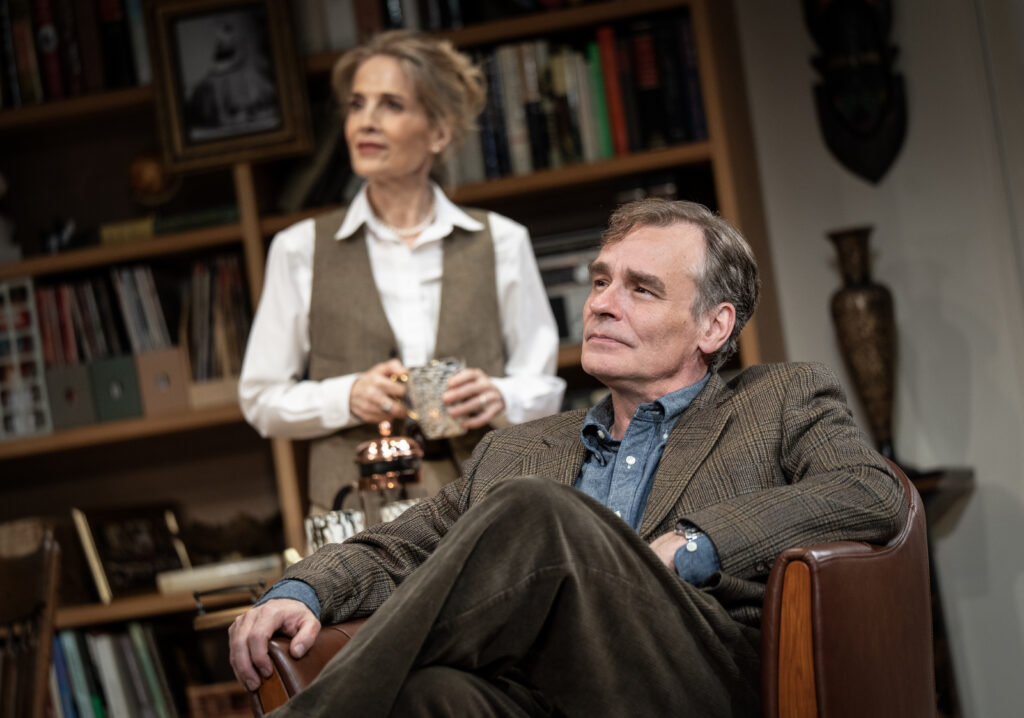
Given all this and the lackluster direction by Sarna Lapine, it’s no surprise that the performances are for the most part one-dimensional. It’s a shame because the company includes some fine actors. In particular, Robert Sean Leonard is reduced to playing a sad sack, ineffectual husband. When he has an affair with the feminist author Quincy Quince, it’s an undeveloped and gratuitous plot point and reduces him to spouting cliches like “it was meaningless.” As Quince, Carmen Zilles never moves beyond smug, self-satisfaction and a mass of shallow attitudes, which reduces the character to a straw man for Wasserstein’s arguments. Montego Glover, however, brings a lot of energy to the role of Dr. Judith B. Kaufman, Lyssa’s best friend who is trying to have a baby by in vitro—another plot point that seems to have no bearing on the central story. Glover, though, at least is charming and energetic. Mary Beth Peil comes closest to being a real person as Chubby, Lyssa’s father the Senator’s fourth wife. While the character seems intended to be a caricature, Peil provides some real insight into who this woman is and what she’s about as a political wife who knows exactly what she’s doing. Jean Lichty as Lyssa seems to have nothing going on beneath the surface, which is a pity since the play is about her personal struggle, though the fault is almost entirely in the script. Lichty is also hampered by a faux-patrician accent, which sometimes makes her speech unintelligible. The rest of the company hits their marks adequately, and that’s the best that can be said given the weakness of the writing.
The set by Mikiko Suzuki Macadams is quite lovely, though the lighting by Alan C. Edwards is only serviceable, if at times a little forced with unnecessary specials. Interestingly, there is no credit for costume design, which shows. For the men the clothes lean heavily towards mid-tier department store at the end of the last century. As for Lyssa, if you’re going to put your lead character in a Chanel-style suit for an important TV interview, get a better knock-off. This may sound petty, but it matters. These are people who consider every action they take in terms of how it will play. They are blindingly affluent, but for the most part they look cheap.
Perhaps, though, for all its supposed good intentions, the play is simply too personal and indulgent to be satisfying theatrically. When it was originally written, Wasserstein was raging at Hillary Clinton’s “cookiegate” and Zoe Baird’s “nannygate” scandals, which targeted powerful women and which “would never have happened to men.” The subplot of Dr. Kaufman’s attempt to conceive mirrored Wasserstein’s own and her fraught relationship with playwright Terrence McNally with whom she wanted to have a child. (She did a year after the play debuted but not with Terrence.) It’s all rather a lot, and in this production after a lugubrious two-and-a-half hours, one is left thinking that these issues might have been more successfully resolved for Wasserstein on a therapist’s couch than on the stage.
An American Daughter
Irene Diamond Stage at Signature Center
4480 West 42nd Street
Tues-Sat 7 p.m.; Sat, Sun 2 p.m. through September 20
$59-$149 at Ovationtix
2 hours, 30 mins, 1 intermission
Photos provided by the production. Photo credit: Joan Marcus
Featured photo Jean Lichty & Robert Sean Leonard
Posted August 12, 2026
More Stories
‘Oh, Mary! ‘Oh, Alaska!
Burlesque in Connecticut
2026 Fall Arts Preview