



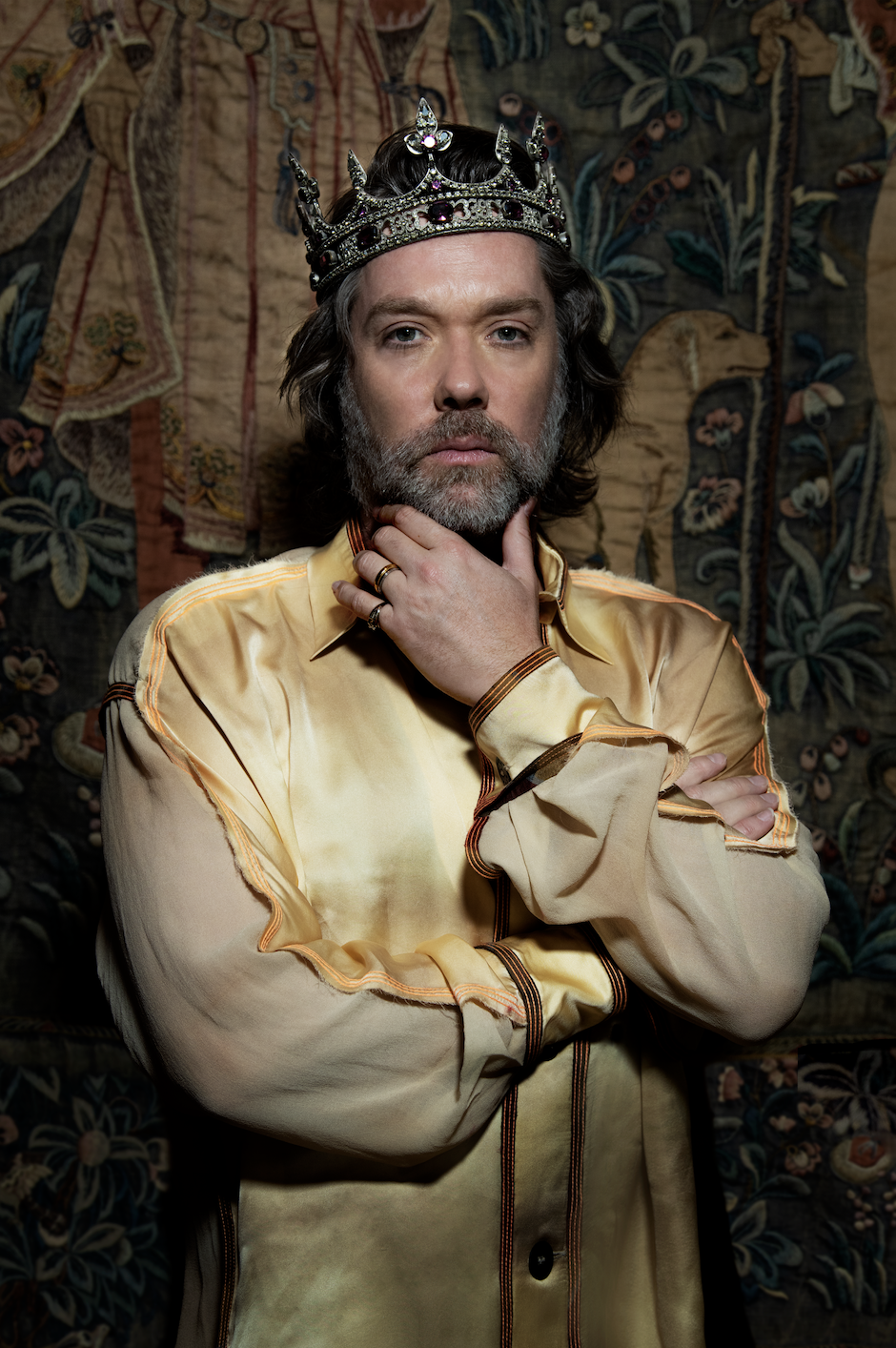

RUFUS WAINWRIGHT
By Brian Scott Lipton
To the musical manner born, as the son of legendary folk singers Loudon Wainwright III and Kate McGarrigle, 53-year-old Rufus Wainwright has carved out a career as one of today’s most eclectic and acclaimed musicians, producing nearly a dozen studio albums, as well as working on operas, musical theater and film soundtracks.
Wainwright is also a frequent touring artist, with numerous dates this fall around the world. On November 21, he’ll appear at Connecticut’s Jorgensen Center for the Arts with his show Wanted, which combines selections from his classic, Grammy-nominated tribute album Rufus Does Judy at Carnegie Hall and his two symphonic-oriented albums Want One and Want Two.
Connecticut Voice recently spoke to Wainwright about how his background has affected him, his initial exposure to Judy Garland, recording his newest CD, I’m a Stranger Here Myself: Wainwright Does Weill, his political activism as a gay man—married to arts administrator Jorn Weisbrodt—and which celebrities are listed in his phone (and the one name he wants to add).
CV: Given your family background, do you feel like a career in music was preordained or did you ever feel like there was something else you could do? Were you ever tempted to rebel and just say, “Screw it, I’m not doing this.”
RW: Music was preordained for sure! My first crib was actually a guitar case. My dad was working on an album and when my mother arrived home from the hospital there was no crib there, so they just put me in the guitar case. So, I was anointed at that point. But whether it was the circumstances of my birth or my ability for music or my passion for it, they were always in sync. I feel incredibly fortunate. It really has always been my calling.
CV: Over your career, you have branched out in so many different directions. Was that a plan, or do these projects come about because how the mood takes you at any particular time?
RW: When I started my career in the pop world, I had already been a big opera fan for many, many years—since I was 13 or so. I had this deep and very passionate knowledge about opera, so when I started making my first record, I treated that as sort of like a secret ingredient. I was able to kind of throw in certain ideas and certain dramatic structures that my contemporaries really didn’t know about, and I thought would take people by surprise. It became a way to differentiate me, which was initially a good idea. But later, it became harder to market me.
CV: Is that why you started recording such diverse projects?

RW: Not exactly. But at some point, I felt it was important to give back to the spirits that got me to where I was going. I think that may have even started with the Judy Garland record because she had influenced me so much as a singer. I wanted to lay my offering at her temple, as it were.

CV: Do you remember when and how you first got exposed to her?
I was very young, maybe three or four. I think I’m the last generation that never had a VCR so you could only see old movies on television when they were actually on. Every year around Thanksgiving, The Wizard of Oz would be on TV, and that was a true family event. Everybody would sit down and watch it together. Seeing Judy in that movie somehow impacted me deeply. Later, when I went to move to Hollywood to make my first record, I got more into the idea of Hollywood glamor and pizzazz, so I got into her Hollywood era of filmmaking. And then later when I got more into substance abuse, I could relate to her struggle with addiction. So, she followed me into these different periods of my early life. [Note: Wainwright laughed wryly at this last comment.]
CV: A few months ago, you released I’m a Stranger Here Myself: Wainwright Does Weill. All of a sudden, did you wake up one morning and say, “I’m doing a Kurt Weill album?”
No, that album was completely from left field! I was working tirelessly on a musical in London called Opening Night, which was based on the John Cassavettes movie, and then a friend said to me “Oh, there’s this orchestra in LA called the Pacific Jazz Orchestra and they’d love to do something with you, Rufus.” And I said, “you know, I love Kurt Weill a lot, and I’ve never really sung a group of his songs.” And next thing you know, they booked a gig and I was flying to LA for like two days to do the show. And then at the last minute they said, “Oh, why don’t we record it?” And, and lo and behold, the album was born.
CV: Are you happy with it?
RW: I think what’s interesting about that album is that I was so exhausted when I recorded that between working on musical and being jet lagged and so forth. But I think all of that actually adds something to the recording. I mean, there’s a kind of weariness to the performance that it needed, I think if you’re too spruced up for Kurt Weill, it doesn’t really work. You got to be a little bit destroyed to sing his work!
CV: In general, are you the kind of artist who can leave your work in the studio or the stage, or do you have to bring it home?
RW: No, it all comes home eventually. And, you know, I wish I was different. Lately. I’ve really gotten into Randy Newman’s work intensely. And one of the biggest shocks that I ever received was when I was talking to someone about his songs, and they just kind of casually said, “Oh, yeah, all of his songs have nothing to do with his life. And he doesn’t write about himself.” But alas, I didn’t take that path!
CV: Was that something you got from childhood? Did your parents take everything home, too?
RW: They took everything home; but I think as a family, we had an easier time communicating in song than in real life. So, yeah, I am not to be blamed for the situation I’m in!
CV: Did you purposely decide not to marry a musician for that reason?
RW: Yeah. I’ve never been able to, shall we say, cross-pollinate with other artists. Both my parents were musicians, and it was quite fruitful creatively, but the marriage kind of died on the vine!
CV: Speaking of marriage—and segueing into gay marriage and politics—I know that about two years ago, you really blasted Donald Trump for using your version of Leonard Cohen’s “Hallelujah” at one of his campaign rallies. That was very important, and even very brave. Is that your nature, or do you feel the need to be political, especially as a gay man, in our current climate?
I feel the need, but I think everybody should feel the need to be political at this point. It’s not a luxury. The s..t has hit the fan, and it’s splattering everywhere. It’s just a question of being a good citizen or, or even a good human being at this point. And I also consider it a fight for survival in a lot of ways. I think it’s important for everybody to choose their battles and really focus on what affects you personally, as well as society. Right now, for me, it is gay rights and trans rights. But it’s also the environment and voting rights. Fighting for these things can take up all your time. And we must remember that we’re in a basket with so many other people who are losing their rights or having them trampled on!
CV: Speaking of people in your particular basket, I’m curious—how far in advance did you have to call Meryl Streep to do your album Dream Requiem?
RW: Very early on. She’s a pretty popular person, you know. Actually, I texted her since I’ve known her for years. And she agreed to do it, which was very, very sweet.
CV: Who would be the person we’d be most surprised to find in your phone?
RW: Usher! I mean, I don’t talk to him often, but he is in my phone.
CV: OK, who do you want to be in your phone who’s not in your phone now?
RW: Well, I’m quite liking the Pope these days. I’d love to call him for a certain papal perspective.
CV: What would you ask him?
RW: Right now, I would just ask him to pray for us, please!
Rufus Wainwright will perform at the Jorgensen Center on November 20, and at Ridgefield Playhouse on November 21. For tickets and other dates, go to gotickets.com and search on Rufus Wainwright.
More Stories
Small Caucus, Mighty Legislative Agenda
“It’s very scary and very exciting”: Jacques Lamarre on the World Premiere of Circus Fire and Building a Life in Hartford
How Can They Keep from Singing?