





An Artistic Life in the Theater: David Greenspan’s sui generis career
By Frank Rizzo
First of all, I’m assuming you don’t know David Greenspan.
But if you do, you just might feel that you’re part of a privileged sect, like wine connoisseurs who speak with breathless awe of a rare and rich vintage.
That’s how some theater aficionados react when recalling a performance by Greenspan, whether it’s his six-hour solo tour de force in 2017 of Eugene O’Neill’s Strange Interlude, which it took him a year-and-a-half to memorize; his mesmerizing Harold in a 1996 revival of The Boys in the Band; or, most recently, as both an Anna Wintour-fierce media manager and a tender gay butler to a wayward royal in off-Broadway’s Prince Faggot by Jordan Tannahill.
Greenspan’s work as a writer has also earned fans and followers, and includes 2003’s gender-playful farce She Stoops to Comedy, a 2009 collaboration with Stephin Merritt of The Magnetic Fields in a musical adaptation of Neil Gaiman’s Coraline, his 2018 stage adaptation of Thornton Wilder’s The Bridge at San Luis Rey, and his early breakout piece, the 1991 matricidal comedy Dead Mother, or Shirley Not All in Vain, in which he played a sensitive son as well as his Jewish mother returning from the dead to continue her harangues.
Playwright Tony Kushner (Angels in America) called that production “a masterpiece and one of the greatest evenings in the theater that I have ever spent. Kushner went on to later say: “I think David Greenspan is one of the most important theater artists of our time. I don’t think it. I know it.”
Greenspan has been a working theater artist for almost half a century, though he doesn’t look his age. (He’s in his late 60s.) In person, Greenspan has a worldview serenity of a humanities professor, a soft-yet-specific voice of a therapist, and a slender physique of a retired dancer, all which belies the striking figures he projects in characters that fill a life—and a stage.
On his day off from Tannahill’s play—and rallying from days of being under weather, we meet at a cafe in New York City’’s West Village, not far from the modest artist-subsided apartment which he shares with his longtime partner of more than 40 years, painter William Kennon.
The play’s dicey title is, in itself, a trigger warning for a production, which includes scenes of brazen and scintillating sexual coupling, rough play and bondage. “It’s purposeful and all in the service of the work,” he says. The play is set a few years in the future and imagines Prince George of Wales—son of William and Catherine, and heir to the throne of England—as an 18-year-old libidinous, rebellious and spiraling gay man in a relationship with a self-assured man of South Asian heritage. Jesse Green writing in The New York Times called the play “inflammatory, nose-thumbing, explicit to the point of pornography, wild and undisciplined (except in its bondage scenes)—and thrilling.”

For more than 40 years, Greenspan has acted in his own shows and those of others; and as a writer of both solo works and ensemble productions. Over the decades, his body of work has earned him six Obie Awards, including one for sustained achievement in the theatre.

Greenspan has been called “a classicist in experimental clothing” and many of his works have derived from—or been inspired by—heady source material by writers such as Gertrude Stein, Aristotle, Aristophanes, and Homer. But with his transformative skills as an actor and his clarity of vision, Greenspan makes even the most esoteric theme accessible, beguiling and thought-provoking.
He also has a fondness for figures and works that have long faded from memory but have been resurrected and re-imagined by him, playing silent star Theda Bara, to writing about obscure actress Helen Twelvetrees to presenting a nearly forgotten romantic comedy from the ‘20s (20th century ’20s, that is) called The Patsy in which he again played all the roles.
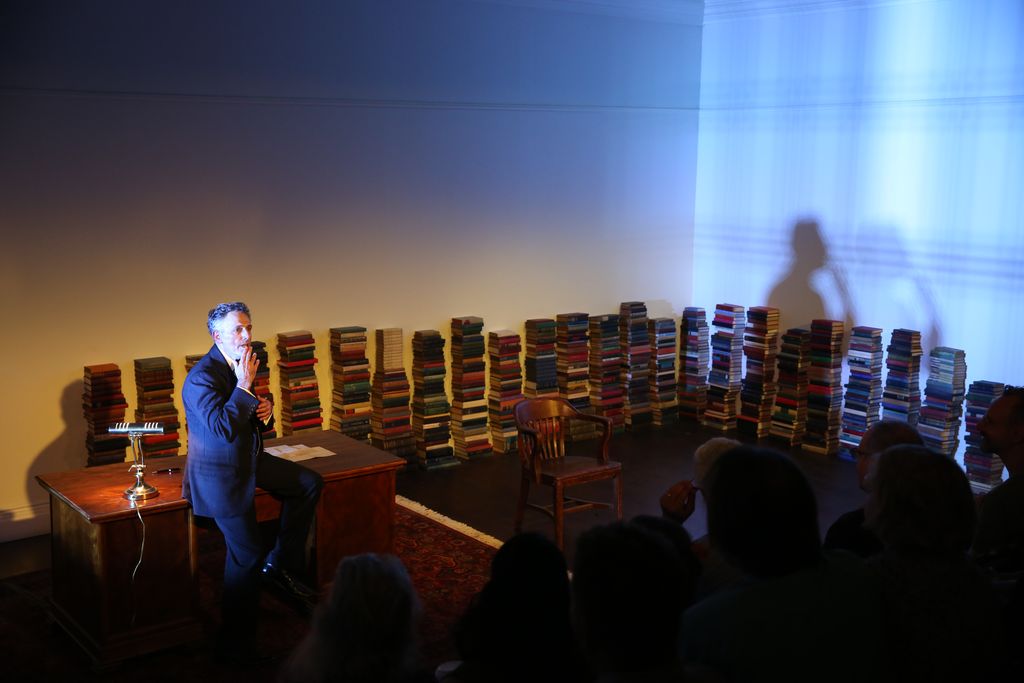
Some Assumption
But when playwright Mona Pinot asked him to perform in a multi-character solo play, it seemed this project was too much, indeed too meta, for even him to take on. It was a play titled I’m Assuming You Know David Greenspan, which Pinot specifically wrote for and was indirectly about Greenspan, whom she did not know personally, in which he knew nothing about, and in which could only be performed by him. “Well, I just didn’t know what to say,” says Greenspan, still agog at the initial proposal.
But Greenspan’s partner knew what to say: “It’s very funny, it reminds me of one of your early works—and you shouldn’t do it. You just can’t say these [laudatory] things about yourself.”
But as a courtesy to the playwright (“She’s a nice young woman, so I felt at least I should read it out loud for her”), he participated in a reading, which snowballed eventually to a widely-praised production. Laura Collins-Hughes writing in The New York Times of its off-Broadway production this past spring called Greenspan a “downtown wonder” and described the play as “an attentive ode to Greenspan’s extraordinary artistry as a playwright-performer.”
Greenspan grew to accept that the work’s spotlight on his acclaimed-but-hardscrabble career was a potent means to talk about something greater than himself. The play’s millennial female characters—all performed by Greenspan with dazzling detail—discuss, argue, and ponder “what it is to be a theater artist in America and what one sacrifices in that personal pursuit.”
“When I speak to young writers and actors,” said Greenspan, “I tell them one of the things they have to ask themselves is what are they willing to do [to be artists]? Uncertainty is built into everyone’s profession, but it’s really built into a performing artist’s profession. A painter can still paint, but a performer and playwright needs an audience for their work to be realized. So what are are willing to do? How do you navigate and manage working and not-working and earning a living.
“I’m always disenchanted when people get awards and then say to young people, ‘You have to hold on!’ because getting awards is not the reason you hold on. You hold on because you have a passion for it—or you don’t and then you realize it’s just not for you. And there’s nothing wrong with that. When people hold up awards and go ‘Hold on!’ that suggests if you don’t stick with it, you’ve done something wrong. You failed.”
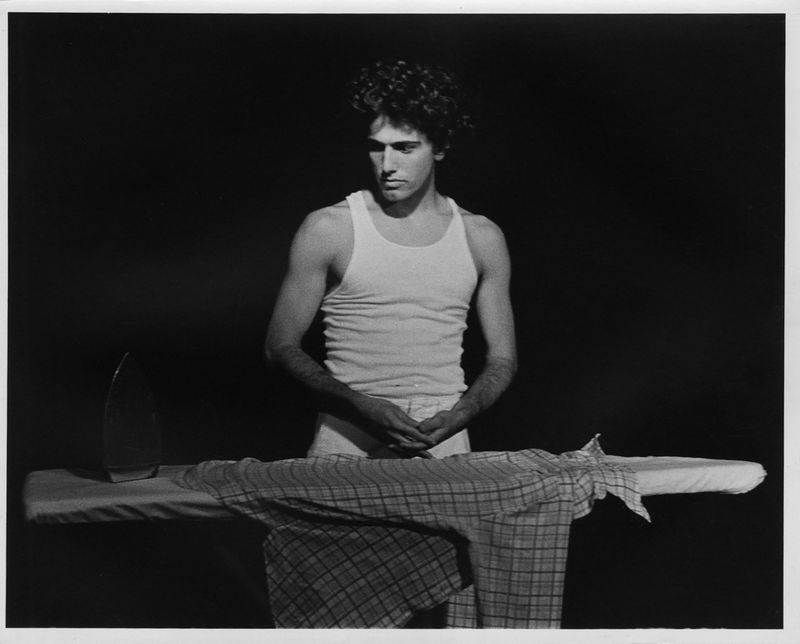
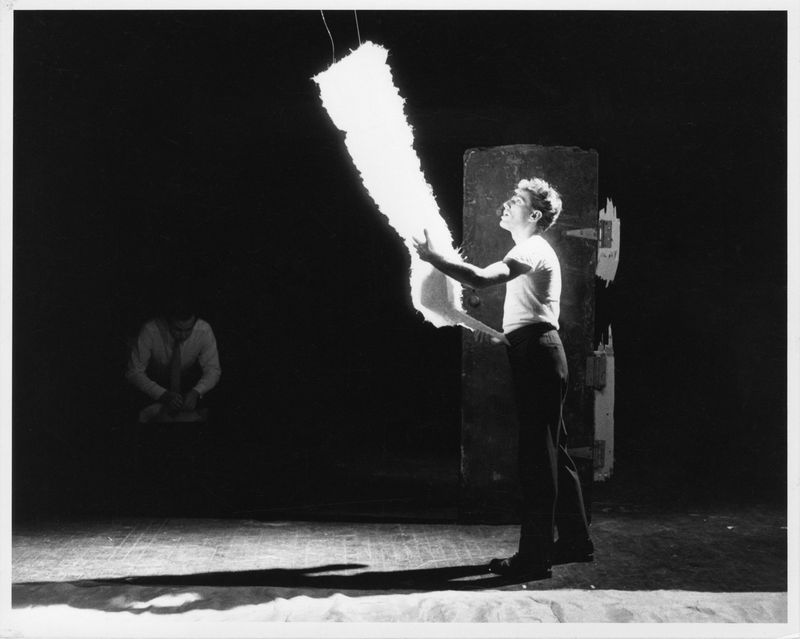
Starting Out
Greenspan has stuck with it his entire life.
He grew up in Los Angeles in the ‘60s and early ‘70s, the son of an aeronautical engineer. His love of theater began when he watched the annual televised showings of the musical “Peter Pan” starring Mary Martin. “It had a tremendous impact on me,” he said. Broadway musicals on record and on the radio also tapped into his psyche from an early age. “I later became a musical geek, immersed in doing after-school drama programs.”
He went on to major in drama in at the University of California at Irvine, but he also took classes in ballet and modern dance, which gave him a sense of comportment, grace and stylistic gesture he would later utilize to great effect in his work.
Greenspan found the theater scene in Los Angeles lacking, so after college in 1978 he headed to New York where he has primarily performed as an actor, which soon led to writing as well. There were a few regional gigs, along the way though, including David Grimm’s The Learned Ladies of Park Avenue at Hartford Stage in 2005 and David Adjmi’s Marie Antoinette at Yale Repertory Theatre in 2012. (“It was the second time I played a sheep.”)
He had a brief stint as an understudy in Broadway’s Hairspray in the early aughts, an experience he would like to forget. (“I basically spent a year in a dressing room, which was the theatrical equivalent to roadkill where you just lay there every night as the show rolls over you.”) For most of his career though, he has been synonymous with off-Broadway and being the quintessential’ downtown artist.”
Greenspan’s next projects sound like yet another curious excursion into content and form.
In February at the Brick Theatre in Williamsburg, Brooklyn Greenspan will be performing in Jerry Lieblich’s Without Mirrors, which is described as a “new experimental language solo play that explores hopelessness, isolation and a perhaps misguided search for a fundamentally ‘true’ self.”
Also on tap is another exploration of the classics with a “Greenspanian” flair; this time taking on Homer.
I asked him if he was starting out today as a young artist if could he still have the same type of career he had.
“I don’t know if there is that much difference,” he said, “People were making the same complaints then that they are now. Artists are doing the same things to make their art, hanging their own lights, using tips from the waiter jobs to make things work, to make art. The only thing that’s changed really is real estate. It’s now Bushwick as opposed to the East Village. I find the young people no less determined in creating their own opportunities. There were no ‘good old days.’ It’s always been the same struggle.”
More Stories
Burlesque in Connecticut
2026 Fall Arts Preview
Off Broadway Review: An American Daughter