




Color Me Complex
Girl, Interrupted is Heartfelt, Searing and Spectacular
BY CHRISTOPHER BYRNE
In April of 2023, my partner and I traveled to Amsterdam to see the Vermeer exhibit at the Rijksmuseum. Though there were only 28 paintings to be seen (of 37 known), we stayed in the gallery for nearly three hours. We marveled at the artistry, of course, and Vermeer’s famous use of light, but we were also stunned at how he imbued ordinary people with life and depth. Whether pouring milk, reading a love letter, or practicing an instrument, Vermeer was the first painter to make these people serious subjects, their simple humanity and quotidian activities filling the canvases, creating a bond and resonating with us, even some 360 years later.
One in particular, “Girl Interrupted at Her Music” was particularly haunting. As with most of Vermeer’s paintings, the scenes invite the viewer to complete the narrative as they experience it—a kind of fine art Rorschach test, if you will. In this painting, a man stands over a woman, dominating her with his presence as she looks out at the viewer. Her expression is baffled, annoyed, resigned? That’s for the viewer to determine. Is this her teacher? A suitor? It’s unknown. Yet what’s clear is that the man is exerting his power and the girl is being forced into compliance, though her ambivalence and disquiet are evident. One gets the sense that she is quietly, cautiously resisting whatever is going on.
This painting becomes a framing (pun intended) device for the spectacular new musical, Girl, Interrupted now at the Public Theater in Manhattan. Based on the memoir and movie of the same name, it is the story of Susanna who signed herself into a mental institution at age 18 after a suicide attempt. While that act appears volitional, it’s clear that even in the late 1960s, a young woman was largely controlled by the men around her and institutionalizing Susanna appears rooted in its time and the male hegemony that minimized and largely dismissed women, certainly any mental health issues. “Difficult” women should just be put away. Susanna commits herself based 15-minute session with a doctor she had never met previously.
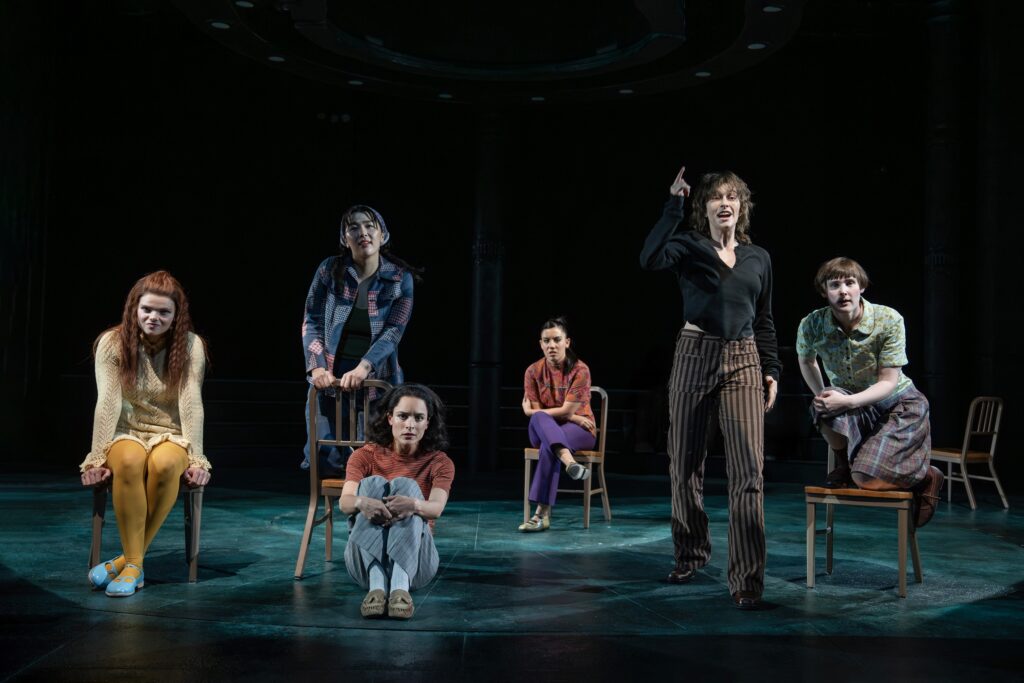
The piece with a book by Martyna Majok and music by Aimee Mann chronicles Susanna’s 18-month stay at McLean Hospital in Massachusetts. There, she meets, bonds, and shares life with five other patients. Each is in treatment for severe mental disorders: Polly who tried to set herself on fire, Tori, a speed freak, Grace, Susanna’s roommate who appears to suffer from depression, Daisy who suffers from crushing OCD, and Lisa who is hypersexual, and aggressive. She calls herself a psychopath, but the others constantly correct her; she is a sociopath.
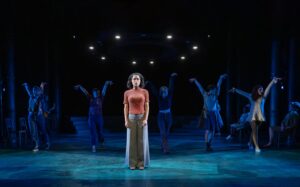
The show is structured as a song cycle. Susanna enters the institution and sings “You Fall,” setting the tone for the rest of the piece with the lyric, “You’re not made of unbreakable stuff.” Over the course of two hours without intermission, and under the sublime and sensitive direction of Jo Bonney, we see just how these women are, or have been, broken. We see how cavalier and misogynistic the diagnoses are, “Give me 15 minutes, that’s all I need to make the call,” the doctor sings in a chilling number. For some, healing is possible, and, at least in Susanna’s case, escape to a “normal” life for a woman in that era. Spoiler alert: she needs to be in the care of a man because there is no way she could live and support herself independently.
For others, they cannot escape their illnesses. Their suffering is at times grueling to watch, as many of them are helpless in their pain. It takes on an amplified poignancy, particularly knowing how far mental health treatment has evolved in the last fifty years. Underneath all the stories, however, are women who are seeking, searching, desperate to be seen and heard. That struggle is too often ongoing for women (and other minorities) today, which gives the piece both a tragic timelessness and an immediacy that wrenches the heart. Somehow, and perhaps against all odds, the patients at McClean do create a loving, accepting community among themselves and find a kind of healing, however tenuous.
Mann’s music is very much in the spirit of soft rock of the late 1960s, and with brilliant orchestrations by Todd Almond, it manages to invoke the time while sounding contemporary. As sung by the cast, the songs draw us deeper into the characters. Under Andrea Grody’s inspired musical direction, the cast sings in straight tones, evocative of the period, yet the lack of vocal embellishment underscores the emotional heft of the songs.

The cast is uniformly excellent. Juliana Canfield as Susanna is the literal and moral center of the piece. Since the piece is presented as a flashback, Canfield has to play Susanna both at 18 and 40, and she does it with a centered grace that allows us to see the younger woman in the older one. Her singing is beautiful and pristine, and the whole performance is notable for its depth and simplicity.

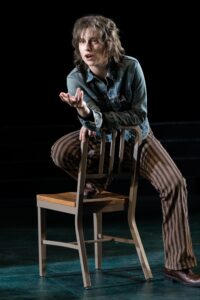
King Princess is raw and electric as Lisa. Her aggression masks her fragility, and it’s a nuanced performance of a young woman both lost and determined to survive, with an almost animalistic drive.
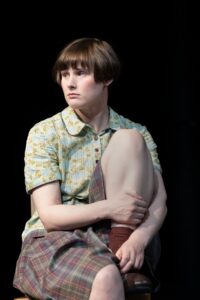
The breakout performance in the piece, however, is Sally Shaw. She plays Polly, the girl who tried to burn herself up. It’s a deceptively complex performance starting with the simplicity of excitement over the fact that they will be having green beans at dinner that night as she welcomes Susanna to the hospital. Though it’s never expressly stated, it seems evident that Polly suffers from bioplar disorder; the initial greeting was a manic episode. Later, though, in a coup de théâtre that is breathtaking, she sings “Burn it Out,” a song that delves into Polly’s depression and the incessant struggle with demons. Shaw gives a galvanizing, star-making performance with a focus and fire that leaves the audience gasping.
Gabi Campo as Tori, Mia Pak as Grace, and Katherine Reis as Daisy are all superlative in their roles. The six women are on stage for most of the show and also serve as a chorus and a ghostly reminder of the suffering that hangs over the hospital.
In smaller roles Manoel Feliciano, Emily Skinner, Ta’Rea Campbell, and Lauren Jeann Thomas fill out the world of the piece. Feliciano in particular plays a character called The Male Presence. It’s a genius move by writer Majok, creating the sense that the entire male establishment is a looming specter overpowering and controlling these women—much as in the Vermeer painting.
We see the painting again in the final moments of the show, as older Susanna comes back to it in the Frick. She escaped McLean and built a life, of sorts, for herself. She chose marriage because it was the only way the medical establishment thought she could survive in the world. Not surprisingly, from the vantage of 40, she sees the painting differently. In a world that may not have changed, Susanna, however, has. She comes to understand that she does have power, even if, for now, it’s only deep within herself. Ultimately, Susanna’s story of the road she traveled is carefully hopeful, and that has made all the difference.
Girl, Interrupted
The Public Theater
425 Lafayette Street, Manhattan
Tues-Sun 7 p.m.; Sat, Sun 1 p.m. (2 p.m. in July) through July 12
$129 at publictheater.org
2 hours, no intermission
Featured image above: Katherine Reis, Mia Pak, Juliana Canfield, Gabi Gampo, King Princess, and Sally Shaw in the world premiere stage adaptation of Girl Interrupted at The Public Theater, with a book by Martyna Majok, based on the book by Susanna Kaysen, original music by Aimee Mann, choreography by Sonya Tayeh, and directed by Jo Bonney
Photos provided by the production © Joan Marcus. Used with permission.
Posted June 4, 2026
More Stories
‘Oh, Mary! ‘Oh, Alaska!
Burlesque in Connecticut
2026 Fall Arts Preview