




Fertility Care Law
By Jane Latus
In May, Connecticut became the seventh state to require private insurance to cover this care for all, by changing the old definition of infertility: the inability of opposite-sex partners to conceive after a year of unprotected sex.
The law now defines infertility as “the need for medical intervention, including, but not limited to, the use of donor gametes, donor embryos or a gestational surrogate, to establish a pregnancy either as an individual or with a partner.”
The impact will be literally life changing. As in new life versus no new life. It will enable families to make financial decisions that could have lifelong positive ramifications. And it will provide a sense of fairness and dignity from the ability to access care just like anyone else—care that you, by the way, paid for.
The law’s passage was top priority for the legislature’s LGBTQ+ Caucus last session (see “Small Caucus, Mighty Legislative Agenda” in the spring CT VOICE). It is the result of two decades of advocacy by the coalition Fertility Access CT (FACT)—led by GLAD Law and including Equality CT, Planned Parenthood of Southern New England, the Center for Reproductive Rights and other organizations.
Advocates are thrilled despite seeing it as incomplete because the change doesn’t apply to HUSKY, Connecticut’s Medicaid program. They’re buoyed by the fact that the bill was bipartisan from start to finish, passing unanimously in the senate, and nearly so (140 to 8) in the house.
Still, the climate is ugly enough that several people hurt by the previous law, and who had sought help from legislators and advocacy groups, declined to speak to CT VOICE, citing the hateful online comments on news stories after the bill’s passage. VOICE can report, however, that the old law stopped LGBTQ+ Connecticut residents from becoming parents. It forced them to pick and choose from their dreams of home ownership, wedding celebrations and parenthood. It dictated where they could afford to live. They took on second and third jobs. They took out loans. They adopted instead, paying out-of-pocket.
ONE COUPLE’S STORY
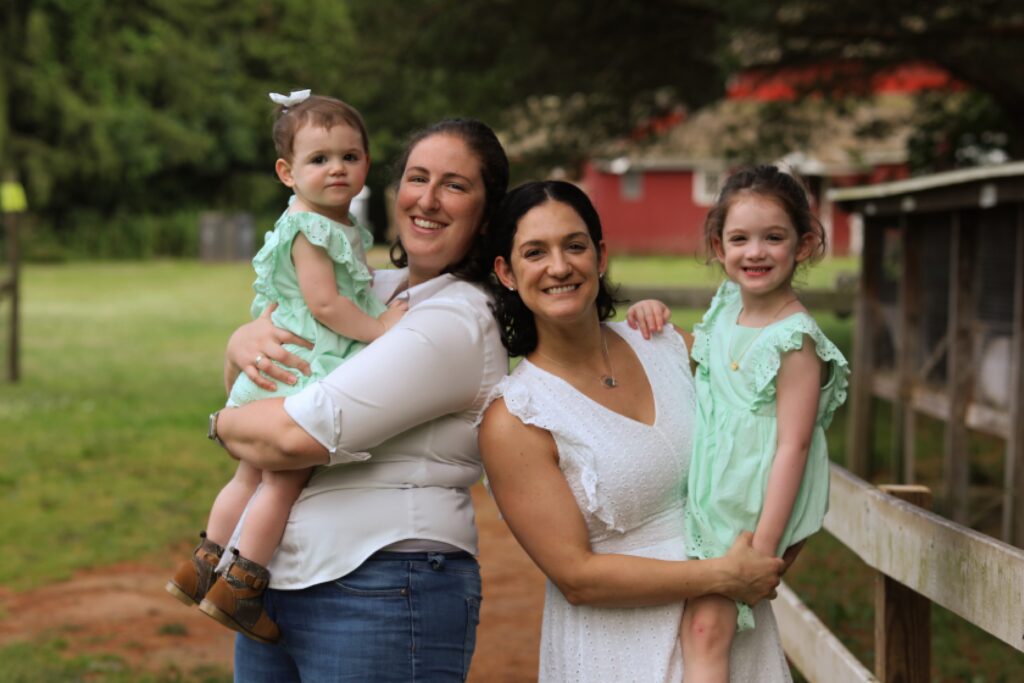
Jenna and Erica Cutler of Hamden, however, are willing to share the old law’s impact on them: $80,000. “Technically we’re fertile. Just together we aren’t fertile,” says Jenna. She says she and her wife are lucky to have careers as an attorney and physical therapist, enabling them to pay to conceive their daughters, now 6 and 3. But she adds, “This bill would have been a complete game changer. It could have impacted where we live. We would have had more money for a down payment.”
When Jenna found out her insurance wouldn’t cover reproductive care, she says, “I remember I was enraged. I went to my employer and said, ‘This is not fair.’” She asked them to cover the cost, which she was aware some firms did at least partially. They declined, and she is now with a different firm.

Adding insult to injury, after their first daughter’s birth, Jenna had to adopt her. This was before the 2021 passage of the Parentage Act, which put an end to that requirement for same-sex parents. (See “DeFacto Parentage & LGBTQ Families” in the spring 2026 CT VOICE.)

It’s too late for the Cutlers, but as an activist who serves on the Connecticut Bar Association LGBT Section and is past chair of the National LGBTQ+ Bar Association, Jenna is relieved for others. “We have a lot of friends who wanted to have kids and were not able to because of the cost.”
And she’s counting living in Connecticut as a blessing. “At least in a time when a lot of states are repealing the rights of people based on their identity, Connecticut is progressing.”
A BASIC, BIPARTISAN NEED
“Fertility healthcare is healthcare that is so core to people’s most basic needs and wants,” says Polly Crozier, director of family advocacy at GLAD Law. “So many people want to build a family, and so many people want to nurture that next generation. And we have heard time and again from people who’ve faced barriers—people who have insurance, but it doesn’t cover it.”
The desire for family is so fundamental, says Crozier, that she wasn’t surprised the bill was bipartisan. Helping the effort, she adds, “A number of legislators and advocates worked very hard to form it that way.” Still she called its passage “really exciting. Honestly, really a bright spot in times that can be so polarizing.”
The bill was introduced and championed by representatives Tammy Nuccio (R)and Raghib Allie-Brennan (D), co-chair of the LGBTQ+ caucus.
Rep. Dominique Johnson (D), the other co-chair of the LGBTQ+ Caucus, says, “It feels amazing to get something done that’s tangible for people.” She adds, “It’s not just for our community. It really does help a large coalition of people who’d like to use IVF on their journey to parenthood.”
According to the Movement Advancement Project, other states requiring private insurers to cover fertility care inclusive of LGBTQ+ people are California, Colorado, Illinois, Maine, New Jersey and New York. Crozier says bills are pending in Massachusetts and Rhode Island.
NEXT UP: HUSKY RECIPIENTS
Advocates’ next goal is to expand the mandate to HUSKY. Last session, FACT drafted a bill to study the possibility, but it was a short session. “We generally ran out of time. It’s something we’ll pick up next session,” says GLAD Law Senior Human Rights Counsel Karla Torres.
Allie-Brennan says, “I think it’s worth continuing the conversation about expanding access to fertility care, including for HUSKY recipients. Any future proposal would require careful consideration of costs and implementation, but I believe everyone deserves a fair opportunity to build a family.”
IF YOU NEED HELP
For free help with insurance issues including denial of benefits, contact the state Office of the Healthcare Advocate. (portal.ct.gov/oha)
GLAD Law Answers provides free legal aid to LGBTQ+ and HIV-positive New Englanders. (gladlaw.org/know-your-rights/)
More Stories
Where The (Elder) Gays Are — And Still Feel Part of a Safe, Supported and Active LGBTQ+ Retirement Community
Thin…But at What Cost? The craze for weight-loss drugs and the LGBQT+ community
Young, Queer Love: How Different Is It?