




Plug and Play: A Cautionary Tale
Matthew Libby’s contemporary play grapples with age old issues.
BY CHRISTOPHER BYRNE
The new play Data now at the Lucille Lortel in Manhattan is playwright Matthew Libby’s contemporary morality play. Ironically, or perhaps not, he sets it in the amoral world of high tech and software development where the question is not whether it’s right to build a program that can be used nefariously but whether it will work and do what the clients want. The “god” to be reckoned with is not the traditional heavenly one, but AI, a god created by man to, at least in some cases, rule over him. The further irony is that just this issue of whether or not AI is godlike was recently covered in the New York Times. However, as the pre-Reformation morality plays point out repeatedly, God can be dangerous, so you better watch out.

The juxtaposition of good and evil is at the center of this taut drama set in the halls of the fictional Athena software company. Behind closed doors, the data analytics department is vying for a government contract to develop a program that will aggregate personal information which it can then run through an algorithm to determine if an individual applying for U.S. citizenship would be a “good” American.
The action gets going when wunderkind programmer Maneesh is taken out of his lower-on-the-totem pole position in UX (user experience) where he designs interfaces with his tech bro mentor Jonah. Riley, a classmate of Maneesh from college, tips off her manager Alex, a tech guru, in data analytics about Maneesh’s college thesis—an algorithm that correctly predicted “rare events” in baseball. Riley has told Alex, about Maneesh and his algorithm, and Maneesh reluctantly moves up and is put on a top-secret program with Riley and Alex.

As the series of short scenes progresses, the darker theme of the play emerges: what does one do in a contemporary world in the face of what is perceived to be immoral? Alex wants Maneesh’s algorithm to save his own career and win the contract, though Maneesh has locked it down, fearful of what it could do, particularly when he rewrites it and sees that his parents’ immigration would have been compromised. Riley needs to keep her job to pay her school loans and care for her mother. Jonah, though he’s not qualified, wants to move into data analytics. Riley wants to expose the program as evil but doesn’t want to lose her job so will only be an anonymous source. She enrolls Maneesh in trying to leak details to the media when he realizes it might have affected his life. Alex only cares to win the contract. His point of view is someone will build it anyway, so why shouldn’t they get the contract? Jonah will do anything to get that promotion and despite his “bro-speak” to Maneesh will sell out anyone to get his goal, even if it’s not what he imagined. Perhaps everyone has their personal reasons for whatever actions they take, but what if their action, or inaction, can hurt others? The piece reflects philosopher Robert Nozick’s arguments about the atomic bomb, which focus on the loss of individual rights—in that case not to be murdered—to serve “the greater good,” a theory he calls unacceptable.
In many ways, the piece is also like Shelley’s Frankenstein in that it examines the dangers of ambition at the expense of a moral compass, and the notion sometimes applied to technology: just because you can doesn’t mean you should. In this case, the monster is an algorithm that can ostensibly identify people as “not right” based on incomplete data and the potential, or inevitable, biased writing of the algorithm. It is the reliance on the data to be absolute, even when it’s flawed, that is the hubris here. As Alex says, “data is the language of our time. And like all languages, its narrative will be written by the victors.” This is scary stuff, particularly in light of the current, real-world use of data in immigration, which daily reveals its flaws and dangers.

The challenge of Data in the structure. It is written like a screenplay with many short scenes punctuated by blackouts. The characters, then, don’t have the space to be more fully developed, and some of the plot twists seemed forced and implausible. Like an algorithm, the audience is required to bring their own programming to the story, rather than be led into a more developed argument.
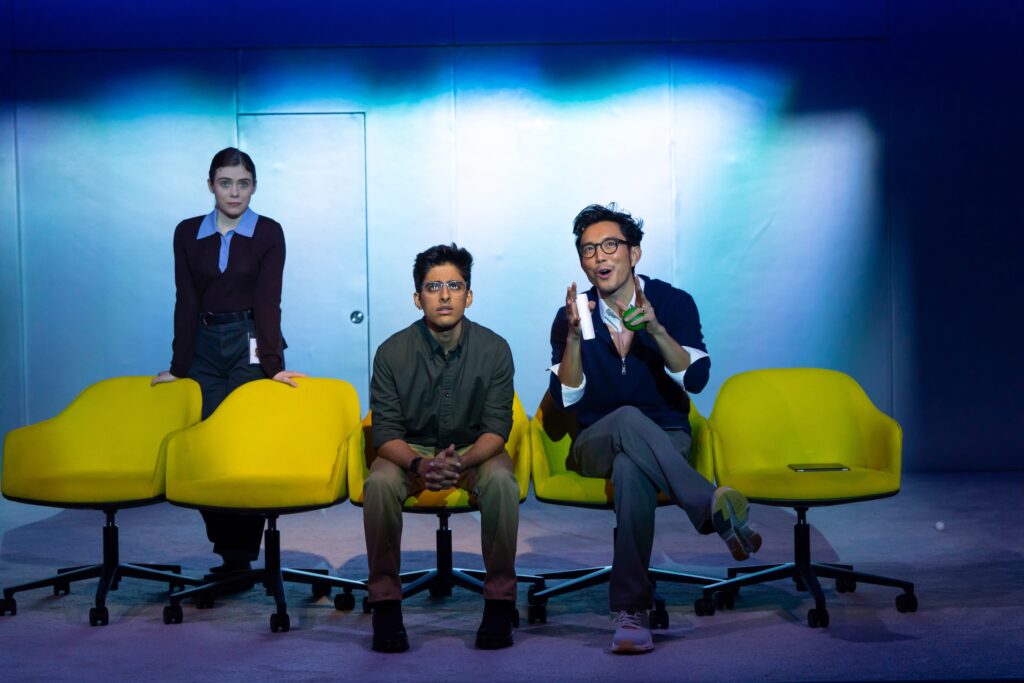
Nonetheless, director Tyne Rafaeli does manage to create a sense of tension throughout. On a stark set designed by Marsha Ginsberg with exceptional lighting by Amith Chandrashaker, the piece has a brash starkness that manages to keep it interesting.
There are also four fine performances. Karan Brar is excellent as the conflicted Maneesh. Sophia Lillis is often powerful as the overwrought, highly pressured Riley. Justin H. Min, is at times chilling in a clear portrayal of the amoral Alex. Brandon Flynn, though, stand out as the most conflicted, and sometimes most human, character. Though he’s a tech bro who admits he’s not that smart, he still has a predatory nature despite his ineptitude. It’s wonderfully “cringe,” as they say.

In the end, there is no resolution. On one hand it’s tempting to say that Libby has written himself into a corner and doesn’t know how to end it. On the other, we might be chilled to think that the data will roll on…and we have no earthly idea of where it will take us.

Data
Lucille Lortel Theatre
121 Christopher Street, Manhattan
Tues-Sat 7:30 p.m.; Sat, Sun 3 p.m.
$49-$191 here
1 hour, 40 mins, no intermission
Posted January 29, 2026
Photos by T. Charles Erickson, provided by the production/
More Stories
Burlesque in Connecticut
2026 Fall Arts Preview
Off Broadway Review: An American Daughter